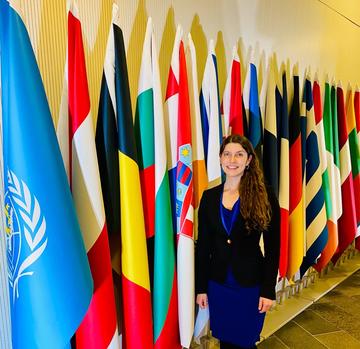
An Advisory Role at WHO Europe
From September to November 2025, I completed a placement with the Behavioural and Cultural Insights (BCI) Unit at the World Health Organization Regional Office for Europe in Copenhagen. The unit helps countries apply behavioural and cultural insights, understanding not only how people think, feel and act, but also how social norms, values and everyday contexts shape health behaviours, to improve public health policy. My role was to translate academic research into practical tools that WHO teams and Member States can use in real-world decision-making.
Why behavioural science matters
Many of today’s biggest health challenges - obesity, heart disease, low vaccination uptake, misinformation - are not just medical issues. They are behavioural, cultural and social. Policies only work if they fit how people live, what they value and the environments shaping their choices. My placement focused on bridging this gap between research and practice.
What I worked on
1. Behavioural insights for preventing noncommunicable diseases (NCDs)
I developed practical evidence tools to support WHO’s work on healthier diets, a major factor in preventing NCDs such as cardiovascular disease and diabetes. Using a behavioural framework (COM-B), I mapped why people find it difficult to reduce salt, sugar, unhealthy fats and calories and what actually helps.
The key insight: information alone is rarely enough. Food prices, marketing, availability and product reformulation often have stronger effects than awareness campaigns. This evidence helps WHO and countries prioritise the most effective actions.
2. Making health communication more effective
I produced a synthesis on salt-reduction campaigns, showing how communication can better support behaviour change when it is simple, culturally relevant and paired with supportive policies. Insights from focus groups in Georgia illustrated how taste traditions, habits and label readability shape real decisions. This work feeds into guidance for countries designing public health campaigns.
3. Front-of-pack food labelling
I contributed behavioural evidence to WHO discussions on nutrition labels on food packaging. Research shows that clear, interpretive labels (like warning symbols or colour-coded systems) help people make quicker and healthier choices than number-heavy labels. This supports policy conversations across Europe.
4. Immune Patrol: health literacy through games
A major part of my placement focused on Immune Patrol, a WHO educational game that teaches children about health and vaccination. I led a peer-reviewed publication on the initiative and wrote a WHO Europe news article based on interviews with national teams in Belgium, Kazakhstan and Turkmenistan. This helped document how countries collaborate across ministries, adapt the programme to schools and sustain it over time. The work strengthens international learning and visibility for innovative approaches to health literacy.
5. Capacity building
I also contributed to the design of “Learn BCI,” a WHO continuing education course for health professionals on behavioural and cultural approaches. This supports long-term workforce development beyond individual projects.
Knowledge exchange in action
This placement was a two-way process. Academic methods (systematic synthesis, behavioural frameworks) were translated into WHO-ready tools, while I learned how evidence must be adapted to political, cultural and resource realities. Attending the 75th Session of the WHO Regional Committee for Europe and the UN’s 80th anniversary commemoration provided insight into how behavioural evidence informs international health governance.
Impact
For WHO, the placement generated decision-ready behavioural evidence tools to inform policy discussions, strengthened cross-country implementation learning, produced a WHO Europe website publication and contributed to capacity-building resources that support sustained use of behavioural and cultural insights. For me, the placement transformed theoretical expertise into applied strategic and policy capability, strengthening my ability to translate behavioural and cultural insights into decision-ready, scalable solutions, navigate the practical constraints of international health systems, engage diverse stakeholders across policy and industry settings and operate effectively at the research-implementation interface.
Advice for future students
Placements like this are most impactful when you focus on creating tools others can keep using after you leave. Be ready to adapt your research skills to fast timelines, diverse contexts and collaborative work. That’s where knowledge exchange truly happens.
Placements Showcase