
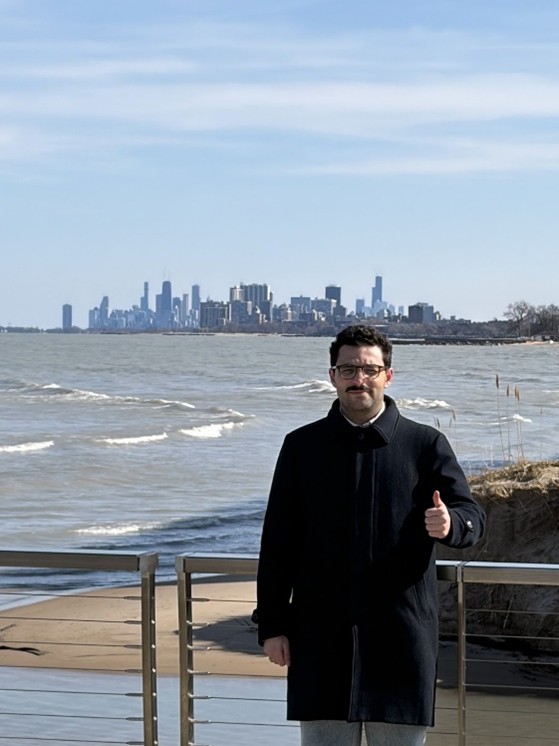
A View of Chicago from Northwestern University via Lake Michigan. Courtesy of Aymen Aulaiwi.
Progress on the Great Lakes
My Overseas Institutional Visit at Northwestern University
I chose to undertake my Overseas Institutional Visit at Northwestern University for two key reasons. First, I had identified academic expertise at the institution that I believe would be hugely beneficial to the success of my doctorate; this came in the form of Professor Jordan Gans-Morse at the Department of Political Science, who had previously written on private security companies in post-Soviet Russia, the subject of my DPhil. Second, I wanted to experience the U.S. academic environment, both to see what value it could bring to my work and to help further my career through further opportunities and networking. On both these fronts, I wholeheartedly believe my visit was a success.
During my visit, I made progress on three core elements of my doctorate. First, through weekly supervisions with Professor Gans-Morse, I was able to construct a new theoretical framework for my research. Because my research pertains to the emergence and evolution of private security companies in post-Soviet Russia, I am interested in how these companies relate both to the economy and our common conceptions of state power. To address the latter, I have built a theoretical model that amends the traditional Weberian definition of the state as the claimant of the monopoly on violence, to form a new definition of the organisation that possesses the primacy of violence. Under this framework, all violence within a territory operates under the state’s oversight, and where such violence threatens the state, the state retains the supremacy to either suppress, co-opt, or accommodate non-state actors. The greater the coercive capacity the state accumulates relative to non-state actors, the more primacy it holds over them, enabling it to increasingly monitor, sanction, and mobilise those actors. Therefore, under this model, it is plausible for private security companies to both coexist and even support post-Soviet Russia’s state-building.
I presented this model and other doctoral research at the Midwest Political Science Association (MPSA) Conference in April of this year, where I received valuable feedback from my peers. I am currently writing up a standalone article based on the primacy of violence model, with the intention of submitting it for publishing in the coming month.
Second, during my time at Northwestern, I audited a post-graduate course on causal inference for social scientists. As a result, I was able to relearn and expand my knowledge of econometric techniques that can be applied to my quantitative data on post-Soviet Russia’s private security companies, including staggered difference-in-difference, regression discontinuity design, and synthetic control tests. For example, I have been able to better assess the efficacy of private security companies in enforcing property rights, relative to public law enforcement, by using diff-in-diff to exploit a 2016 legal change that reduced the number of firms operating in Russia. I am currently working on refining these results and robustness checks, which I hope to present at a Russia studies conference in Berlin in October.
Lastly, through collaboration with fellow doctoral students at Northwestern University, I was able to identify and access further primary sources on Russia’s private security industry to be employed in my qualitative analysis. These resources include regional legislation, private security publications, and State Duma speeches associated with the regulation of the private security industry. Moreover, I was able to work through an archive of interviews and surveys with Russian business owners and private security heads, conducted by Professor Gans-Morse during the 2000s and early 2010s.
During my time in America, I was also able to make major inroads in my academic career. Through networking with academics and fellow doctoral students across Northwestern University, at the MPSA conference, and prearranged visits to New York and Washington D.C., I have been able to open doors for future funding and career advancement. In particular, I have built a good relationship with the Institute for Humane Studies based at George Mason University, who have been keen to support my DPhil project.
Overall, my time at Northwestern University was incredibly useful, both in supporting my DPhil research and my future academic career. Moreover, I cannot speak more highly of the academic and social environment of the United States, where I was able to build strong friendships both inside and outside of the university. While moving to a new country for a few months is never easy, it is a challenge worth pursuing, both for your academic progress and personal growth.